How it works: Scotts cleaning unit on the receiving hopper
10/10/2025
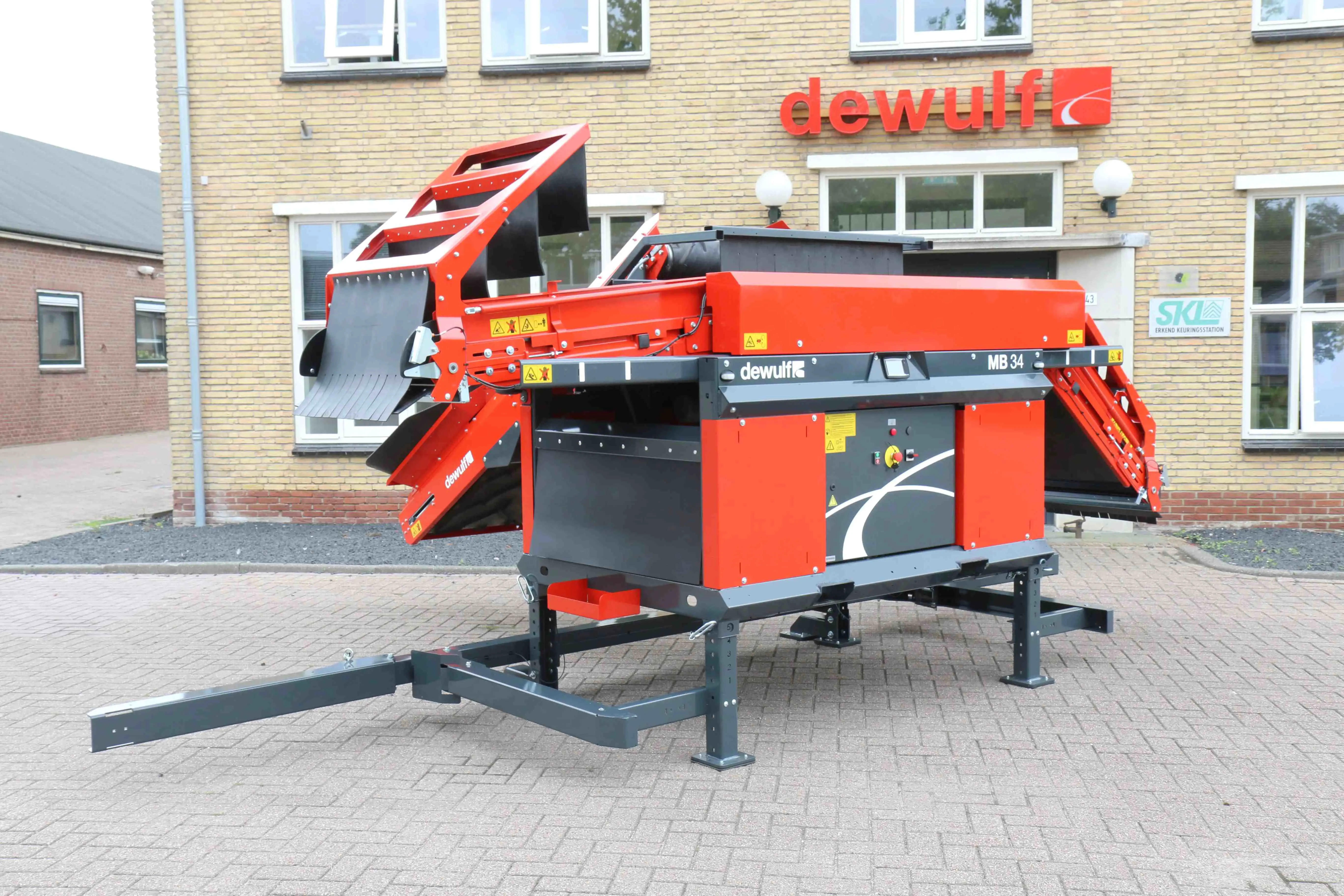
Storage of potatoes is a challenge when harvesting conditions are less than ideal. Dewulf offers a solution that works under all circumstances: the Scotts cleaning unit on the MH 241 and MH 242 receiving hoppers.
The key principle in potato cleaning is that the tubers roll. That way you can quickly remove adhering or sticky soil. But under dry conditions you actually want to leave a little soil in the batch. That soil then acts as a buffer for moisture release and uptake, which helps to prevent tuber damage.
A commonly used cleaner on harvesters and discharge bunkers is a roller cleaner, with rollers in many shapes and sizes. The British manufacturer Scotts has developed a cleaning unit in which, in different versions, the cleaning rollers rotate either with or against the flow. Moreover, the spacing between the rollers is also adjustable. Dewulf applies the Scotts cleaning technology to its MH receiving hopper series.
Electric motors
In the downward‑sloping base frame of the cleaning module, there is a thick spiral roller followed by a smooth roller. Both the spiral (ribbed) rollers and the smooth rollers are driven by electric motors: the spiral rollers at one side of the machine, the smooth rollers on the other side. The advantage of electric motors is that the speed (rpm) is well controllable and their power can be well protected against overload.
When using the Scotts Evolution cleaning unit, both types of rollers are available in different versions. You can choose spiral rollers with more or fewer ribs, and the rib height can also be adjusted. The small smooth rollers can also be rubber‑coated for better grip on the product. The type of roller fitted thus partially determines the cleaning options.
Adjustment options
The smooth rollers can be configured in several ways: direction of rotation, speed, and height. The smooth rollers are always adjusted as a pair. This means that by changing one setting via the control box (for example the height relative to the spiral rollers), the height of two paired rollers will change. The adjustment possibilities of the spiral rollers are more limited: only the speed (rpm) and the gap opening (clearance) relative to the smooth rollers are adjustable. The spiral rollers carry the product, and their ribs grip and break down the debris. On soft, smooth, and round products the ribs have more difficulty gaining grip. The product then stays between the rollers and is nearly cleaned only by the spiral ribs.
The last, somewhat smaller, roller in the Scotts cleaning module is the throughput roller. This roller is differently shaped, and is also a bit smaller than the thick spiral roller, for a better transition to the next module. It cannot be adjusted individually. The throughput roller is driven by the electric motor of the final smooth rollers. That means its speed is nearly the same as that of the last smooth rollers.
Because of the variation in settings of the smooth rollers, under nearly all conditions a suitable cleaning setting can be found: intensive cleaning when there is a lot of adhering soil, or minimal cleaning under dry conditions, so that a little loose soil remains in the product batch for optimal storage.
Easyclean
Dewulf currently places this cleaning module only in the receiving hopper. In self‑propelled harvesters we apply a comparable concept: the Easyclean module. The advantage of a cleaning unit on the discharge bunker is its high capacity and the wide range of cleaning options, depending on conditions.
Text: LandbouwMechanisatie